
Last Updated: August 2026
Published by: Saif Pharma — a specialist oncology medicine supplier serving patients, pharmacies, and distributors worldwide.
Medical Review: Reviewed by Dr. Farhan Hossain, MBBS, MD (Oncology)
Content Basis: This article is based on official prescribing information, product monographs, and regulatory product documentation from SFDA and DGDA (Directorate General of Drug Administration, Bangladesh).
Sources: oriopharma.com, lenvanix.com, drugs.com, drugs.com, accessdata.fda.gov, accessdata.fda.gov, accessdata.fda.gov

Key Takeaways
- Lenvatinib is a multi-kinase inhibitor approved for locally recurrent or metastatic, progressive, radioactive iodine-refractory differentiated thyroid cancer (DTC) in patients 18 years and older.
- It works by inhibiting VEGFR1-3, FGFR1-4, PDGFRα, KIT, and RET, limiting tumor angiogenesis and proliferative signaling.
- Lenvatinib capsules are available in 4 mg and 10 mg strengths, allowing physicians to tailor treatment plans per prescribing information.
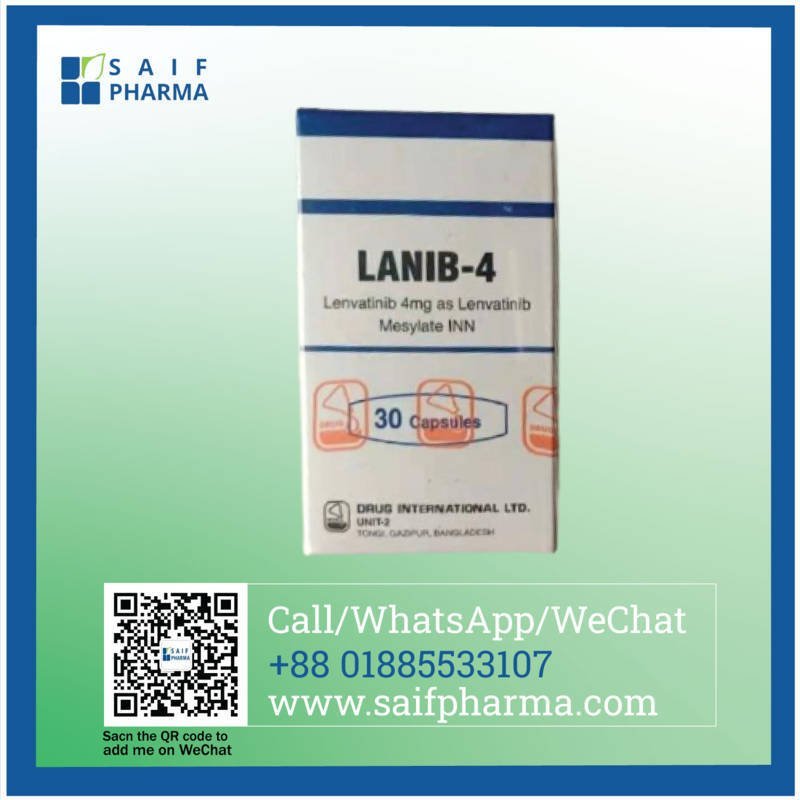
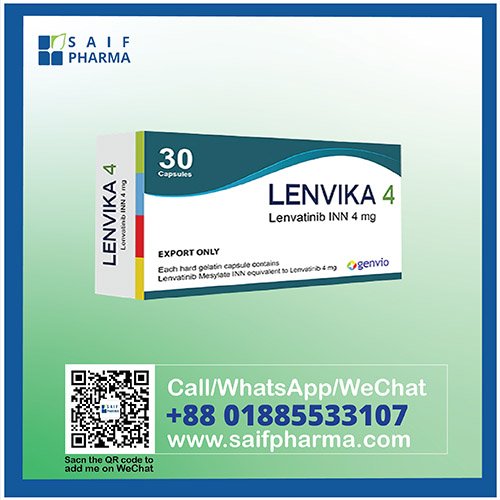
- We supply Bangladeshi-manufactured lenvatinib brands — Lanib, Lenvaxen, and Lenvanix — for export to Pakistan, India, and Bangladesh, with Lenvanix registered by Bangladesh’s Directorate General of Drug Administration & Licensing Authority (Drugs).
- Exports to Saudi Arabia are supported with documentation aligned to Saudi Food and Drug Authority (SFDA) registration and import requirements.
Overview of Lenvatinib for Thyroid Cancer
Lenvatinib is an antineoplastic agent belonging to the multi-kinase inhibitor therapeutic class, developed for use in patients with locally recurrent or metastatic, progressive, radioactive iodine-refractory differentiated thyroid cancer (DTC). This class of oral targeted therapies has become an important treatment option for patients whose thyroid tumors no longer respond to conventional radioactive iodine therapy, offering a systemic approach to disease control.
As a Bangladeshi pharmaceutical exporter, we supply Lenvatinib under the Bangladeshi-manufactured brand names Lenvika, Lanib, Lenvaxen, and Lenvanix. These products are formulated as oral capsules and are manufactured to meet international quality standards for export to regulated and semi-regulated markets, including Saudi Arabia. Lenvanix, one of our supplied brands, is registered with the Directorate General of Drug Administration & Licensing Authority (Drugs) of Bangladesh, reflecting the regulatory oversight applied to locally manufactured oncology products.
Healthcare institutions, distributors, and procurement teams in Saudi Arabia seeking a consistent, quality-assured source of lenvatinib capsules can rely on our portfolio of Bangladeshi-manufactured brands. Each brand is produced under standardized manufacturing conditions, supporting reliable supply chains for oncology pharmacies and hospital procurement departments requiring RAI-refractory DTC therapies.
This overview is intended for licensed healthcare professionals, hospital procurement teams, and pharmaceutical distributors. It is not a substitute for the approved prescribing information, and clinical decisions regarding lenvatinib therapy should be made by a qualified oncologist based on individual patient assessment.

Mechanism of Action
Lenvatinib functions as a kinase inhibitor with a broad target profile relevant to tumor growth and vascularization. It inhibits the kinase activity of vascular endothelial growth factor receptors VEGFR1, VEGFR2, and VEGFR3, which play a central role in tumor angiogenesis — the process by which tumors develop new blood vessels to sustain growth and metastatic spread.
Beyond VEGFR inhibition, lenvatinib also targets fibroblast growth factor receptors FGFR1 through FGFR4, platelet-derived growth factor receptor alpha (PDGFRα), KIT, and RET. This multi-target kinase inhibition profile allows lenvatinib to interfere with several signaling pathways implicated in tumor cell proliferation, survival, and angiogenesis simultaneously.
By suppressing these interconnected pathways, lenvatinib limits the tumor’s ability to recruit new vasculature and sustain proliferative signaling, contributing to its therapeutic effect in radioactive iodine-refractory differentiated thyroid cancer and other approved solid tumor indications. This mechanism underlies its classification within the multi-kinase inhibitor lenvatinib target category widely referenced in oncology literature and forms the pharmacological basis described in the approved product labeling.

Approved Indications and Clinical Use
Lenvatinib carries several approved oncology indications, each defined for patients aged 18 years and older. The primary indication relevant to this article is locally recurrent or metastatic, progressive, radioactive iodine-refractory differentiated thyroid cancer (DTC) in adult patients 18 years and older.
In addition to its DTC indication, lenvatinib is approved for advanced renal cell carcinoma (RCC) in adult patients 18 years and older, used in combination with pembrolizumab as a first-line treatment, and separately in combination with everolimus following prior anti-angiogenic therapy. Lenvatinib is also approved as a first-line treatment for hepatocellular carcinoma (HCC) in adult patients 18 years and older, and for endometrial carcinoma in combination with pembrolizumab in adult patients 18 years and older.
Across all indications, specific dosing regimens, combination schedules, and treatment durations are determined by the treating physician in accordance with the official prescribing information. Procurement teams and clinicians should always refer to the approved product labeling for indication-specific administration guidance rather than general reference sources. Institutional buyers are encouraged to cross-check indication data against the regulatory dossier accompanying each shipment to confirm consistency with local labeling requirements.
Available Strengths and Packaging
Lenvatinib is supplied as an oral capsule formulation available in two strengths: 4 mg and 10 mg capsules. These strengths allow treating physicians flexibility in tailoring capsule combinations to individual treatment plans as specified in the prescribing information, without requiring reference to specific numeric dosing here.
For B2B procurement purposes, our Bangladeshi-manufactured brands — Lenvika, Lanib, Lenvaxen, and Lenvanix — are available in pharmacy and bulk export pack configurations suited to hospital pharmacies, distributors, and institutional buyers in Saudi Arabia. Packaging is designed to meet export documentation and cold-chain-independent storage standards typical of oral oncology capsules.
Buyers seeking lenvatinib 4mg uses or evaluating strength-specific procurement, including comparisons sometimes made against products such as lenshil 4mg, are advised to consult the official label for administration guidance. Specific regimen details, including which strength combinations apply to particular indications, must always be confirmed against the current approved prescribing information and the treating physician’s instructions. Our regulatory affairs team can provide batch-specific certificates of analysis upon request to support institutional quality assurance reviews.

Safety Information and Side Effects
Common side effects associated with lenvatinib therapy include hypertension, fatigue, diarrhea, arthralgia/myalgia, decreased appetite, weight decreased, nausea, stomatitis, headache, vomiting, proteinuria, palmar-plantar erythrodysesthesia syndrome, abdominal pain, and dysphonia. These effects are typically monitored throughout the course of treatment by the prescribing oncologist.
Serious adverse events linked to lenvatinib include hepatotoxicity, hemorrhage, cardiac dysfunction, arterial thromboembolic events, renal failure and impairment, gastrointestinal perforation and fistula formation, QT interval prolongation, hypocalcemia, and reversible posterior leukoencephalopathy syndrome (RPLS). When used in combination with everolimus, hepatotoxicity has also been reported.
Given the range and severity of potential adverse effects, prescribing physicians should review the complete safety profile detailed in the official prescribing information before initiating therapy, and patients should be monitored according to institutional oncology protocols throughout treatment.
This safety summary is compiled for informational and procurement-support purposes and reflects information consistent with published prescribing information; it is not intended to replace the full safety labeling, pharmacovigilance reporting obligations, or clinical judgment of the treating physician.
Global Brand Context
Internationally, lenvatinib is recognized under the brand name Lenvima, distributed by its original developer, Eisai Inc., in markets such as the United States. This global branding reflects the molecule’s broader recognition across oncology markets worldwide, including its use in hepatocellular carcinoma treatment protocols associated with eisai hcc programs.
This international context is provided solely for market awareness. Procurement decisions for Saudi Arabia should reference the Bangladeshi-manufactured brands available through our export channels, which are manufactured, registered, and supplied independently of any originator distribution network.
Regulatory Status and Import Compliance in Saudi Arabia
Pharmaceutical imports into Saudi Arabia are governed by the Saudi Food and Drug Authority (SFDA, sfda.gov.sa), which maintains regulatory oversight over the registration, importation, and distribution of oncology medicines within the Kingdom. Suppliers exporting lenvatinib-based products to Saudi Arabia must ensure full compliance with SFDA documentation requirements, including manufacturing quality certifications and product registration dossiers.
As an international reference point, lenvatinib as a molecule received FDA approval in 2015, establishing its regulatory recognition among global health authorities. This approval milestone provides an internationally recognized clinical and regulatory foundation that supports ongoing evaluation of lenvatinib-based therapies by national regulatory bodies, including the SFDA.
We export our Bangladeshi-manufactured lenvatinib brands — Lenvika, Lanib, Lenvaxen, and Lenvanix — to Saudi Arabia in accordance with applicable import regulations. Our export documentation is prepared to support SFDA submission requirements, ensuring that hospital pharmacies, oncology centers, and licensed distributors in Saudi Arabia can access properly certified product with clear regulatory traceability from country of manufacture to point of import. Our regulatory affairs staff maintain up-to-date familiarity with SFDA submission portals and documentation formats, drawing on direct experience preparing oncology export dossiers for the Saudi market.
Why Choose Us as Your Lenvatinib Export Partner
As a Bangladeshi B2B pharmaceutical exporter, we specialize in supplying quality-assured oncology medicines to healthcare markets across the Gulf region, including Saudi Arabia. Our lenvatinib portfolio — Lenvika, Lanib, Lenvaxen, and Lenvanix — is manufactured under regulated conditions in Bangladesh and prepared for international export with full supporting documentation.
We provide comprehensive regulatory documentation support to facilitate SFDA registration and import approval processes, helping distributors and institutional buyers navigate compliance requirements efficiently. Our team is responsive to procurement timelines and works closely with pharmacy buyers, hospital procurement departments, and licensed distributors to ensure consistent product availability.
For institutions evaluating oncology therapies for RAI-refractory DTC alongside other targeted agents — such as those covered in our resources on Osimertinib for EGFR-mutated NSCLC or Lazertinib supply — our portfolio offers a reliable, regulation-conscious sourcing pathway. Contact us for availability and pricing on Lenvika, Lanib, Lenvaxen, and Lenvanix for export to Saudi Arabia.
Frequently Asked Questions
Is lenvatinib a chemotherapy drug?
Lenvatinib is not classified as traditional chemotherapy; it belongs to the multi-kinase inhibitor class of targeted antineoplastic agents. Rather than broadly attacking rapidly dividing cells like conventional chemotherapy, it specifically inhibits kinase receptors such as VEGFR, FGFR, PDGFRα, KIT, and RET that drive tumor blood vessel formation and growth. This targeted mechanism distinguishes it from cytotoxic chemotherapy drugs.
What is the mechanism of action of lenvatinib?
Lenvatinib inhibits the kinase activity of vascular endothelial growth factor receptors VEGFR1, VEGFR2, and VEGFR3, which are central to tumor angiogenesis. It also targets fibroblast growth factor receptors FGFR1 through FGFR4, along with PDGFRα, KIT, and RET, interfering with multiple pathways involved in tumor cell proliferation and survival. This multi-target inhibition limits a tumor’s ability to develop new blood vessels and sustain growth.
What are the most common side effects of lenvatinib?
Commonly reported side effects include hypertension, fatigue, diarrhea, arthralgia and myalgia, decreased appetite, nausea, and palmar-plantar erythrodysesthesia syndrome. Other effects noted include stomatitis, headache, vomiting, proteinuria, and dysphonia. Patients should be monitored by their prescribing oncologist throughout treatment, and any new or worsening symptoms should be reported promptly.
How successful is lenvatinib in treating thyroid cancer?
Lenvatinib is approved specifically for locally recurrent or metastatic, progressive, radioactive iodine-refractory differentiated thyroid cancer, offering a systemic treatment option when tumors no longer respond to radioactive iodine therapy. Treatment outcomes vary by individual patient and disease characteristics, and specific efficacy data should be reviewed with the treating oncologist. The article does not provide specific success rate statistics, so patients should consult official prescribing information and their physician for outcome expectations.
Which Bangladeshi lenvatinib brands are available for export to Saudi Arabia?
We supply four Bangladeshi-manufactured lenvatinib brands for export to Saudi Arabia: Lenvika, Lanib, Lenvaxen, and Lenvanix. These are formulated as oral capsules and manufactured under regulated conditions to meet international quality standards. Lenvanix is registered with the Directorate General of Drug Administration & Licensing Authority (Drugs) of Bangladesh.
What documentation supports SFDA import compliance for these products?
Our export packages are prepared with manufacturing quality certifications and product registration dossiers to support Saudi Food and Drug Authority (SFDA) submission requirements. We provide regulatory documentation support to assist distributors and institutional buyers with the registration and import approval process. This helps ensure hospital pharmacies, oncology centers, and licensed distributors in Saudi Arabia receive product with clear regulatory traceability.
- 1. oriopharma.com
- 2. lenvanix.com
- 3. www.drugs.com
- 4. www.drugs.com
- 5. www.accessdata.fda.gov
- 6. www.accessdata.fda.gov
- 7. www.accessdata.fda.gov
Access This Medicine Through Saif Pharma
We are a specialist oncology medicine supplier delivering to patients, pharmacies, hospitals, and distributors worldwide. Contact us for availability and sourcing support.
We do not publish prices online. All pricing is provided directly by our specialist supply team on request.
Medical Information Notice: This content is for informational purposes only and is based on official pharmaceutical product documentation. It does not constitute medical advice. Patients should consult their doctor or pharmacist before taking any medication.
Regulatory Disclaimer: Sourcing and distribution are subject to regional import regulations, quotas, and verified medical prescriptions where applicable. Pricing and availability are subject to change without notice.
Content Currency: This article was last reviewed and updated in August 2026. Regulatory approval statuses and product availability are subject to change; readers are advised to consult official regulatory databases for the most current information.