




Overview
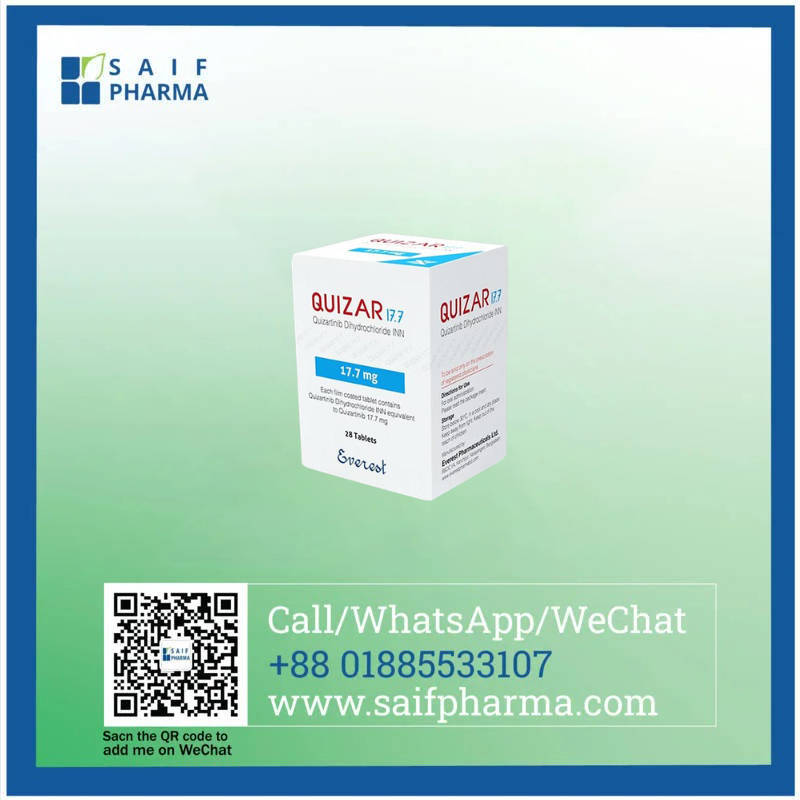
Quizar 17.7 mg contains Quizartinib, a highly selective, second-generation small-molecule tyrosine kinase inhibitor (TKI). Manufactured by Everest Pharmaceuticals Ltd. and supplied by Saif Pharma, Quizar is specifically designed to target the FLT3 receptor, particularly the internal tandem duplication (ITD) mutation. This mutation is one of the most common and aggressive genetic alterations in Acute Myeloid Leukemia (AML), often leading to a higher risk of relapse and shorter survival times. By inhibiting this specific driver, Quizar provides a targeted approach to managing AML in combination with standard chemotherapy.
Therapeutic Applications
Quizar is indicated for:
Newly Diagnosed FLT3-ITD+ AML: For adult patients in combination with standard cytarabine and anthracycline induction and cytarabine consolidation chemotherapy.
Maintenance Therapy: Used as a single-agent maintenance treatment following consolidation chemotherapy for patients who have achieved remission.
Relapsed/Refractory AML: Often utilized in clinical settings for patients whose FLT3-ITD positive AML has returned or failed to respond to initial treatments.
Mechanism of Action
Quizartinib acts as a selective inhibitor of the FMS-like tyrosine kinase 3 (FLT3).
Selective Inhibition: It binds to the ATP-binding site of the FLT3 receptor, blocking its autophosphorylation.
Disrupting Growth Signals: By inhibiting the FLT3-ITD mutation, it shuts down downstream signaling pathways—including STAT5, MAPK/ERK, and PI3K/AKT—which are responsible for the unregulated survival and proliferation of leukemic blasts.
Inducing Apoptosis: This blockade leads to “programmed cell death” (apoptosis) in the cancer cells, reducing the tumor burden in the bone marrow and blood.
Pharmacokinetic Profile
Absorption: Reaches peak plasma concentrations within 2 to 4 hours after oral administration.
Distribution: Highly protein-bound (~99%), ensuring sustained presence in the systemic circulation.
Metabolism: Primarily metabolized by the CYP3A4/5 enzyme system. It has an active metabolite (AC886) that also contributes to its therapeutic effect.
Elimination: Features a long terminal half-life (approximately 73 hours), allowing for consistent once-daily dosing.
Dosage & Administration
Standard Regimen: Typically initiated at 35.4 mg (two 17.7 mg tablets) once daily during the induction and consolidation phases (specific days of the cycle).
Maintenance Dose: Maintenance therapy usually starts at 26.5 mg and may be escalated to 53 mg once daily based on cardiac monitoring (QTcF interval).
Instructions: Tablets must be swallowed whole. Do not crush, cut, or chew. Can be taken with or without food.
Missed Dose: Take as soon as possible on the same day. If it is already the next day, skip the missed dose. Do not take two doses at once. If vomiting occurs, do not take an extra dose; wait for the next scheduled time.
Clinical Considerations & Safety
QT Prolongation (Boxed Warning): Quizartinib can cause life-threatening heart rhythm changes. Baseline and weekly ECG monitoring is mandatory during the first phases of treatment.
Myelosuppression: Can cause severe neutropenia, thrombocytopenia, and anemia. Regular Complete Blood Counts (CBC) are required.
Drug Interactions: Strong CYP3A inhibitors (like ketoconazole) can significantly increase Quizar levels, requiring a dose reduction (e.g., from 35.4 mg to 17.7 mg)
Electrolyte Balance: Hypokalemia and hypomagnesemia must be corrected before and during treatment to minimize cardiac risks.
Special Populations
Pregnancy: Quizartinib is embryo-fetal toxic. Effective contraception is required during treatment and for 7 months (females) or 4 months (males) after the last dose.
Hepatic/Renal Impairment: No dose adjustment is needed for mild to moderate impairment; however, it has not been studied in severe cases.