





Overview
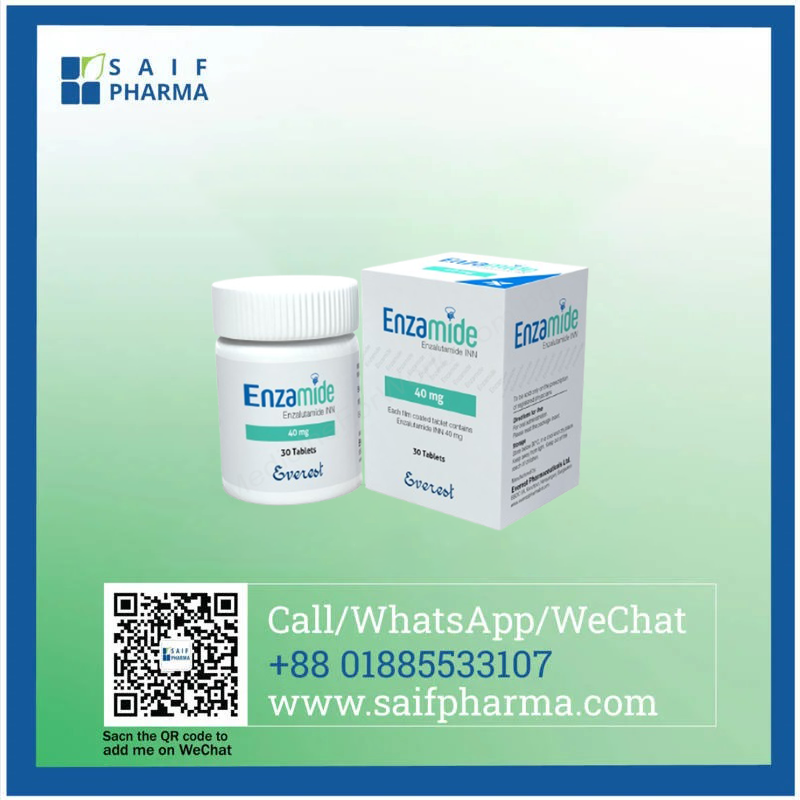
Enzamide 40 mg contains Enzalutamide, a non-steroidal androgen receptor inhibitor. Manufactured by Everest Pharmaceuticals Ltd. and supplied globally by Saif Pharma, Enzamide is a precision oncology therapy engineered to combat advanced prostate cancer. By blocking the cellular pathways that allow testosterone to fuel tumor growth, Enzamide significantly delays disease progression, reduces serum prostate-specific antigen (PSA) levels, and extends overall survival in patients with advanced prostate malignancies.
Therapeutic Applications
Enzamide is primarily indicated for the treatment of adult patients with:
Metastatic Castration-Resistant Prostate Cancer (mCRPC): For patients whose prostate cancer has spread to other parts of the body and no longer responds to medical or surgical treatments that lower testosterone.
Non-Metastatic Castration-Resistant Prostate Cancer (nmCRPC): For patients whose cancer has not yet spread but is actively growing (evidenced by rising PSA levels) despite testosterone-lowering therapies.
Metastatic Castration-Sensitive Prostate Cancer (mCSPC): For patients with advanced, hormone-sensitive prostate cancer that has spread, used in combination with androgen deprivation therapy (ADT).
Mechanism of Action
Enzalutamide functions as a multi-step androgen receptor (AR) signaling inhibitor, attacking the hormone-driven growth of prostate cancer cells at three distinct points:
Androgen Binding Inhibition: It competitively inhibits the binding of natural androgens (like testosterone and dihydrotestosterone) to the androgen receptors inside the cancer cell.
Nuclear Translocation Blockade: It stops the androgen receptor from moving into the cell nucleus, preventing the receptor from carrying out its genetic instructions.
DNA Binding & Transcription Inhibition: Even if the receptor reaches the nucleus, Enzamide prevents it from binding to the DNA. This shuts down the transcription process that tells the cancer cell to replicate, leading to tumor cell death and shrinkage.
Pharmacokinetic Profile
Absorption: Readily absorbed after oral administration, reaching peak plasma concentration ($T_{max}$) within 1 to 2 hours.
Distribution: Highly bound to human plasma proteins (~97% to 98%), primarily to albumin, ensuring sustained drug circulation.
Metabolism: Primarily metabolized in the liver via the CYP2C8 and CYP3A4 enzyme systems. It forms an active metabolite (N-desmethyl enzalutamide) that is equally potent.
Elimination: Displays an exceptionally long terminal elimination half-life of approximately 5.8 days, which ensures steady-state therapeutic levels with simple daily dosing.
Dosage & Administration
Standard Adult Dose: The recommended therapeutic dose is 160 mg taken orally once daily. This requires taking four 40 mg tablets together at the same time each day.
Instructions: Tablets must be swallowed whole with a glass of water. Do not crush, chew, split, or dissolve them. It can be taken with or without food.
Androgen Deprivation: Patients who have not undergone surgical castration must continue concurrent medical castration with a gonadotropin-releasing hormone (GnRH) analog throughout Enzamide therapy.
Clinical Considerations & Safety
Seizure Risk: Enzalutamide carries an increased risk of seizures. Use with caution in patients with a history of epilepsy, stroke, brain injury, or those taking medications that lower the seizure threshold. Discontinue permanently if a seizure develops.
Posterior Reversible Encephalopathy Syndrome (PRES): This rare, reversible neurological disorder has been reported. Symptoms include headache, confusion, visual loss, or seizures. Confirm with brain imaging (MRI) if suspected.
Ischemic Heart Disease: Cardiovascular events, including myocardial infarction, have occurred. Monitor patients with known ischemic heart disease closely.
Falls and Fractures: Enzamide can cause dizziness and muscular weakness, leading to an increased risk of falls and subsequent bone fractures. Bone-targeted therapies should be considered for high-risk patients.
Drug Interactions: Enzalutamide is a strong inducer of CYP3A4 and a moderate inducer of CYP2C9 and CYP2C19. It can significantly decrease the plasma concentrations of concurrent oral medications processed by these enzymes.
Special Populations
Embryo-Fetal Toxicity: Although prescribed to male patients, Enzalutamide can cause severe fetal harm if a pregnant woman is exposed. Males with female partners of reproductive potential must use highly effective contraception during treatment and for 3 months following the final dose.
Hepatic Impairment: No initial dose adjustment is necessary for patients with mild-to-moderate liver impairment; use with caution in severe cases.