Last Updated: August 2026
Published by: Saif Pharma — a specialist oncology medicine supplier serving patients, pharmacies, and distributors worldwide.
Medical Review: Reviewed by Dr. Nusrat Jahan, MBBS, MD (Medical Oncology)
Content Basis: This article is based on official prescribing information, product monographs, and regulatory product documentation from SFDA and DGDA (Directorate General of Drug Administration, Bangladesh).
Sources: medlineplus.gov, drugs.com, ema.europa.eu, accessdata.fda.gov, accessdata.fda.gov, accessdata.fda.gov

Key Takeaways
- Ceritinib is an oral ALK Tyrosine Kinase Inhibitor approved for adults aged 18 years and older with ALK-positive metastatic non-small cell lung cancer confirmed by an FDA-approved diagnostic test.
- It works by blocking ALK autophosphorylation and downstream signaling proteins, suppressing proliferation of cancer cells driven by aberrant ALK activity.
- Ceritinib is available as a 150 mg capsule and a 150 mg tablet, both intended for oral administration under physician-directed regimens.
- Bangladeshi-manufactured brands Cerixen, Erinlar, and Cerinib are supplied exclusively for export to Saudi Arabia and are not sourced from India or other countries.
- Common side effects include diarrhea, nausea, fatigue, and elevated liver enzymes, while serious risks such as hepatotoxicity, interstitial lung disease, and QT prolongation require ongoing physician monitoring.
- Export documentation aligned with SFDA expectations, including manufacturing certificates and certificates of pharmaceutical product, supports import and registration review for Saudi pharmacies, hospitals, and distributors.
Ceritinib Overview: Indication & Mechanism of Action
Ceritinib is an orally administered antineoplastic agent belonging to the Anaplastic Lymphoma Kinase (ALK) Tyrosine Kinase Inhibitor class. It is approved for the treatment of metastatic non-small cell lung cancer (NSCLC) in adult patients aged 18 years and older whose tumors are ALK-positive, as determined by an FDA-approved diagnostic test. This molecular subtype represents a distinct and clinically actionable category of NSCLC that requires targeted therapeutic intervention rather than conventional cytotoxic chemotherapy alone.
Mechanistically, Ceritinib functions as a highly selective and potent inhibitor of the ALK enzyme. It works by inhibiting autophosphorylation of ALK, as well as ALK-mediated phosphorylation of downstream signaling proteins involved in cell proliferation. By interrupting this signaling cascade, Ceritinib suppresses the proliferation of cancer cells that are dependent on aberrant ALK activity for growth and survival. This targeted mechanism distinguishes it from non-selective cytotoxic agents and underlies its clinical role in ALK-driven NSCLC.
Ceritinib is available in two oral dosage forms: a 150 mg capsule and a 150 mg tablet. Both formulations are intended for oral administration, with specific regimen and administration guidance determined by the treating physician based on official prescribing information and individual patient factors. For procurement and clinical planning purposes, pharmacies and institutions in Saudi Arabia should recognize Ceritinib as a molecularly targeted oncology therapy positioned within the broader landscape of ALK- and EGFR-directed treatments used in advanced lung cancer management, a category that also includes agents discussed in resources such as our overview of Osimertinib for EGFR-mutated NSCLC.
Molecular biomarker testing for ALK rearrangement is a prerequisite step that oncology teams and procurement pharmacists should factor into institutional treatment pathways, since Ceritinib’s clinical utility is confined to patients with confirmed ALK-positive disease. Institutions coordinating oncology formulary decisions may find it useful to cross-reference diagnostic testing protocols with treating oncologists prior to product selection, ensuring alignment between confirmed biomarker status and procurement planning.
Available Ceritinib Brands from Bangladesh: Cerixen, Erinlar, Cerinib
As a Bangladeshi pharmaceutical supplier serving the Saudi Arabian market, we exclusively source and export Ceritinib products manufactured in Bangladesh. Our current portfolio includes three brands: Cerixen, Erinlar, and Cerinib, all formulated in line with the approved dosage strengths of 150 mg capsule and 150 mg tablet.
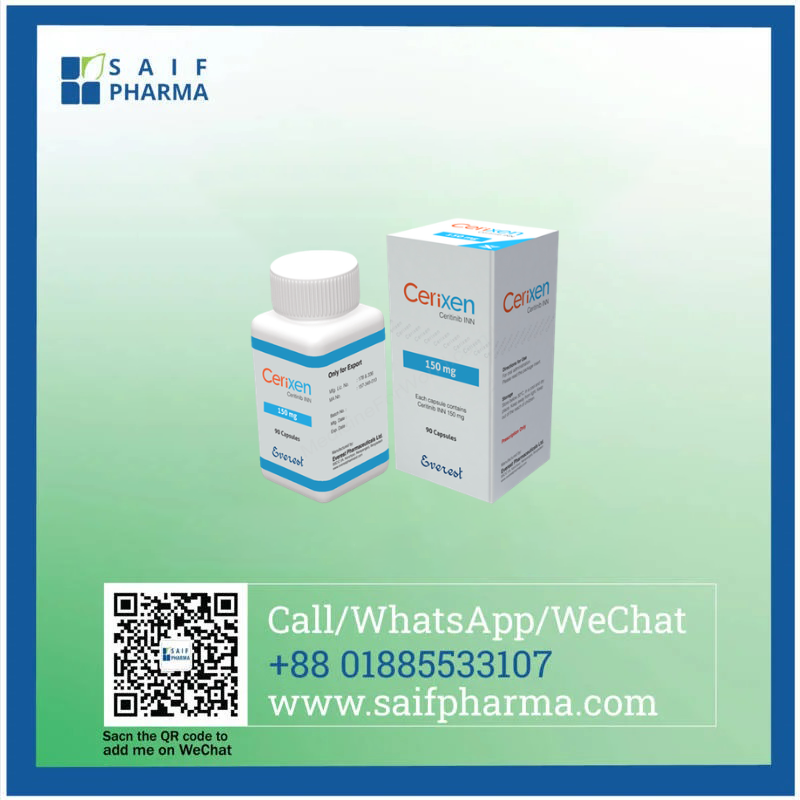
Cerixen is supplied as a 150 mg capsule and is manufactured by Everest Pharmaceuticals Ltd., a Bangladesh-based pharmaceutical manufacturer. Erinlar is produced by Genvio Pharma Ltd., another Bangladeshi manufacturer, and is available for institutional and pharmacy procurement under the same therapeutic class designation as an ALK Tyrosine Kinase Inhibitor. Cerinib rounds out our brand offering, formulated consistent with the same approved strength profile used across the Ceritinib product category.
All three brands are manufactured entirely within Bangladesh and are made available strictly for export markets, including Saudi Arabia. We do not source, distribute, or supply Ceritinib products manufactured in India or any other country outside Bangladesh. This ensures full traceability and consistency in the supply chain for pharmacies, hospitals, and distributors seeking a dependable Bangladeshi origin for their ALK-inhibitor procurement needs.
For general market awareness, it is worth noting that the Ceritinib molecule is also recognized internationally under the brand name Zykadia. This reference is provided solely for context regarding global nomenclature and should not be interpreted as an indication of sourcing or supply availability through our channels. Our procurement and export focus remains firmly on Bangladeshi-manufactured Ceritinib brands only. Institutions evaluating a broader oncology portfolio may also find relevance in related targeted therapies, such as those covered in our article on Lazertinib for EGFR-mutant NSCLC.
Institutional buyers are encouraged to request manufacturer-issued batch documentation, including certificates of analysis and GMP compliance records, directly from us prior to finalizing procurement decisions. This level of documentation transparency reflects standard due-diligence practice for oncology product sourcing and supports internal quality assurance review by receiving pharmacies and hospitals.

Side Effects & Clinical Safety Considerations
Ceritinib therapy is associated with a defined clinical safety profile that requires ongoing physician monitoring throughout treatment. Commonly reported side effects include diarrhea, nausea, vomiting, abdominal pain, fatigue, decreased appetite, and constipation. These effects are generally manageable under clinical supervision but require baseline and periodic assessment.
Given these risks, liver function tests, cardiac monitoring via ECG, and blood glucose surveillance are typically incorporated into the treatment plan by the prescribing physician.
Ceritinib is metabolized primarily through the CYP3A4 pathway, making concomitant use with strong CYP3A4 inhibitors or inducers clinically relevant due to potential drug-drug interactions affecting drug exposure. Prescribers should review a patient’s full medication profile before initiating therapy.
Regarding lactation, women receiving Ceritinib should be advised to avoid breast-feeding during treatment and for two weeks following discontinuation of therapy, reflecting the drug’s systemic pharmacologic activity.
All decisions regarding dose selection, dose modification, treatment interruption, or discontinuation due to adverse events rest solely with the treating physician, based on individual patient response and the official prescribing information. This article does not provide dosing guidance and is intended for procurement and clinical-context reference only.
The safety information summarized here is drawn from publicly available prescribing information and regulatory labeling associated with Ceritinib’s original approval pathway. Institutional pharmacists and clinical staff should always consult the most current official prescribing information and regional labeling documents when advising on monitoring protocols, as safety guidance may be updated over time.
Regulatory Status & Export Compliance for Saudi Arabia
Ceritinib received its initial regulatory approval from the U.S. FDA in 2014, establishing an international precedent for its use in ALK-positive metastatic NSCLC. This approval history is referenced here strictly as global regulatory context and does not constitute a claim of Saudi Arabian marketing authorization.
As a Bangladesh-based pharmaceutical supplier, we do not manufacture Ceritinib products locally in Saudi Arabia. Instead, our Bangladeshi-manufactured brands—Cerixen, Erinlar, and Cerinib—are prepared for export to Saudi Arabia in accordance with the documentation and registration expectations aligned with the Saudi Food and Drug Authority (SFDA, sfda.gov.sa). This includes preparation of manufacturing certificates, certificates of pharmaceutical product (CPP), stability data, and labeling documentation required to support import and registration review by Saudi importers, distributors, or regulatory agents.
Pharmacies, hospitals, and distributors in Saudi Arabia seeking to import Ceritinib brands should coordinate with their designated regulatory or import affairs teams to ensure all SFDA-aligned documentation is submitted correctly for the applicable product registration pathway. Our role as supplier is to provide accurate, compliant manufacturing and quality documentation to support this process, without asserting or implying direct local registration on behalf of any Saudi entity. We recommend early engagement with regulatory consultants familiar with SFDA drug import procedures to streamline timelines for institutional procurement.
Regulatory expectations for oncology imports can evolve, and documentation requirements may vary by product registration pathway or import category. We maintain ongoing communication with our manufacturing partners in Bangladesh to keep export documentation current, and we encourage Saudi-based regulatory teams to verify the latest SFDA guidance directly through official channels as part of their internal compliance review.
Shipping & Export Capability to Saudi Arabia and the GCC
Reliable export logistics are central to supplying oncology products such as Ceritinib to international markets. As a Bangladesh-based supplier, we maintain export processes designed to preserve product integrity from origin through final delivery to Saudi Arabia and neighboring GCC markets, including the UAE, Qatar, Kuwait, Bahrain, and Oman.
Given that Ceritinib is a solid oral dosage form (capsule and tablet), storage and transport are managed according to the manufacturer’s specified handling conditions, with attention to temperature control and packaging integrity throughout transit. Our export operations incorporate documentation support, including certificates of analysis, packing lists, and shipment-specific paperwork required for customs clearance and pharmaceutical import review in destination countries.
We work directly with pharmacies, hospitals, and licensed distributors to coordinate B2B shipments, ensuring that each consignment aligns with the regulatory expectations of the receiving market. Our logistics approach is built around consistency and compliance, minimizing delays that can affect institutional oncology supply chains. For distributors managing multi-product oncology portfolios, we also support export inquiries related to other targeted therapies, including agents referenced in our article on Talazoparib for BRCA-mutated cancers. Institutions are encouraged to contact us directly to discuss specific shipment volumes, timelines, and documentation requirements for their region.
Our export team routinely coordinates with freight partners experienced in pharmaceutical cold-chain and controlled-storage handling, reflecting the operational discipline expected when moving oncology therapies across international borders. This experience-driven approach helps institutional buyers plan procurement timelines with greater confidence.
Pricing & Availability
Current pricing for Cerixen, Erinlar, and Cerinib is not published online, as availability and cost depend on order volume, destination requirements, and prevailing regulatory documentation status at the time of inquiry. We encourage pharmacies, hospitals, and distributors in Saudi Arabia to contact us directly for up-to-date availability, product specifications, and quotation details.
Our team is prepared to support institutional buyers with product documentation, export paperwork, and shipment coordination tailored to Saudi Arabian and broader GCC procurement needs. To initiate an inquiry, please reach out through our contact form, email, or direct phone line to discuss current stock status and export terms for Ceritinib brands.
Frequently Asked Questions
What is ceritinib 150 tablet used for?
Ceritinib, available as a 150 mg tablet or capsule, is used to treat metastatic non-small cell lung cancer in adult patients aged 18 years and older whose tumors are ALK-positive as confirmed by an FDA-approved test.
What are the side effects of ceritinib?
Commonly reported side effects include diarrhea, nausea, vomiting, fatigue, and elevated liver enzymes, along with decreased appetite and rash in some patients.
How does ceritinib work against ALK-positive lung cancer?
Ceritinib is a selective ALK inhibitor that blocks autophosphorylation of the ALK enzyme and downstream signaling proteins involved in cell growth, which suppresses proliferation of cancer cells dependent on ALK activity.
Are there serious risks associated with ceritinib treatment?
Yes, more serious considerations include hepatotoxicity, interstitial lung disease or pneumonitis, and QT interval prolongation, along with hyperglycemia and pancreatitis in some cases.
Which Ceritinib brands are available for export to Saudi Arabia?
We supply three Bangladeshi-manufactured brands—Cerixen, Erinlar, and Cerinib—all formulated at the approved strength profile and prepared for export to Saudi Arabia and other GCC markets.
What documentation supports Ceritinib import into Saudi Arabia?
Our export process includes manufacturing certificates, certificates of pharmaceutical product, stability data, and labeling documentation aligned with SFDA expectations to support import and registration review by Saudi importers or regulatory agents.
- 1. medlineplus.gov
- 2. www.drugs.com
- 3. www.ema.europa.eu
- 4. www.accessdata.fda.gov
- 5. www.accessdata.fda.gov
- 6. www.accessdata.fda.gov
Access This Medicine Through Saif Pharma
We are a specialist oncology medicine supplier delivering to patients, pharmacies, hospitals, and distributors worldwide. Contact us for availability and sourcing support.
We do not publish prices online. All pricing is provided directly by our specialist supply team on request.
Medical Information Notice: This content is for informational purposes only and is based on official pharmaceutical product documentation. It does not constitute medical advice. Patients should consult their doctor or pharmacist before taking any medication.
Regulatory Disclaimer: Sourcing and distribution are subject to regional import regulations, quotas, and verified medical prescriptions where applicable. Pricing and availability are subject to change without notice.
Content Currency: This article was last reviewed and updated in August 2026. Regulatory approval statuses and product availability are subject to change; readers are advised to consult official regulatory databases for the most current information.