
Overview
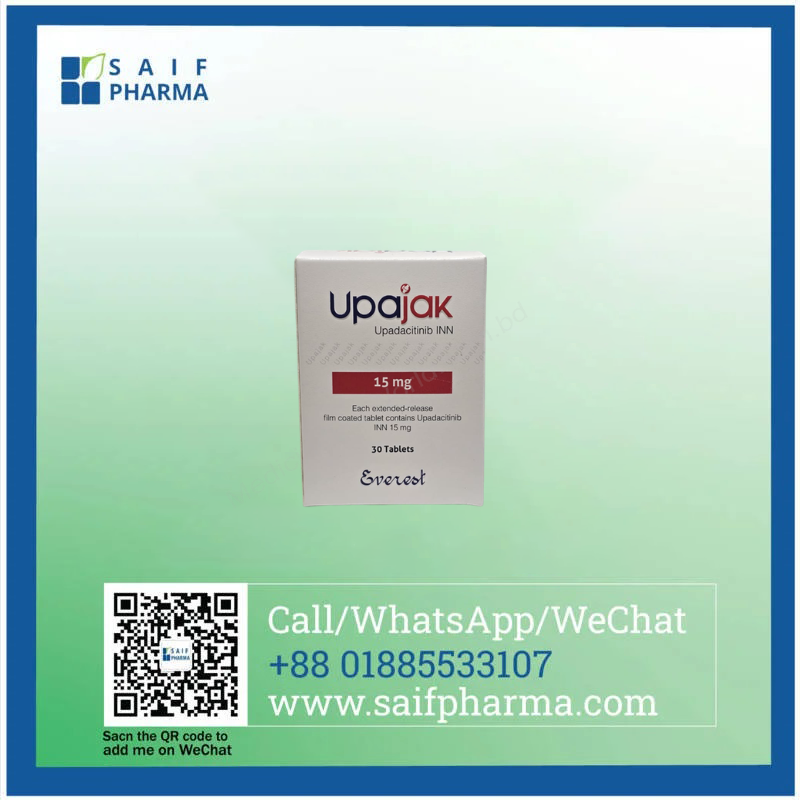
Upajaf 15 mg contains Upadacitinib, a potent, oral, highly selective Janus Kinase 1 (JAK1) inhibitor. Manufactured by Everest Pharmaceuticals Ltd. and supplied globally by Saif Pharma, Upajaf represents a significant advancement in targeted immunology. By preferentially targeting the JAK1 pathway, it blocks specific inflammatory cytokines responsible for immune-mediated diseases. This oral option offers deep clinical remission pathways for patients with moderate-to-severe autoimmune conditions who have shown an inadequate response or intolerance to traditional biologic treatments.
Therapeutic Applications
Upajaf 15 mg is a highly versatile systemic immunomodulator indicated for:
Rheumatoid Arthritis (RA): For adult patients with moderate-to-severe active RA who have had an inadequate response to one or more tumor necrosis factor (TNF) blockers.
Psoriatic Arthritis (PsA): For adults with active psoriatic arthritis who are intolerant to or have had an inadequate response to disease-modifying antirheumatic drugs (DMARDs).
Atopic Dermatitis (Eczema): For adults and adolescents (12 years and older) with refractory, moderate-to-severe atopic dermatitis whose disease is not well controlled with other systemic medications.
Ulcerative Colitis (UC) & Crohn’s Disease (CD): For the maintenance phase treatment of adult patients with moderate-to-severe active UC or Crohn’s disease following an initial induction response.
Ankylosing Spondylitis (AS): For adults with active ankylosing spondylitis who have shown an inadequate response to NSAIDs or biologics.
Mechanism of Action
Upadacitinib functions inside cells to interrupt the signals that drive auto-inflammatory cascades:
Selective JAK1 Blockade: Signaling pathways for inflammatory cytokines rely on the Janus Kinase (JAK) family. Upajaf selectively inhibits JAK1 enzymes over JAK2, JAK3, and TYK2.
Interrupting STAT Activation: By blocking JAK1, it prevents the phosphorylation and activation of STAT proteins (Signal Transducers and Activators of Transcription).
Downregulation of Inflammation: This action effectively halts the gene transcription of pro-inflammatory cytokines (such as IL-2, IL-6, IL-7, IL-15, and IFN-$\gamma$), rapidly reducing systemic inflammation and tissue damage.
Pharmacokinetic Profile
Absorption: Displaying an extended-release profile, it is steadily absorbed throughout the gastrointestinal tract, reaching peak plasma concentration ($T_{max}$) within 2 to 4 hours.
Metabolism: Predominantly metabolized by the liver via the CYP3A4 enzyme system, with a minor contribution from CYP2D6.
Elimination: Cleared from the body with a terminal elimination half-life of approximately 9 to 14 hours, allowing for regular once-daily therapeutic coverage.
Dosage & Administration
Standard Regimen: The typical maintenance dose across most indications (RA, PsA, AS, and Eczema) is 15 mg taken orally once daily.
Instructions: Tablets must be swallowed whole with water. Do not break, crush, split, or chew them, as doing so destroys the extended-release mechanism. It can be taken with or without food.
Clinical Gatekeeping: Treatment should not be initiated if the patient’s Absolute Lymphocyte Count (ALC) is less than 500 cells/$\mu$L, Absolute Neutrophil Count (ANC) is less than 1,000 cells/$\mu$L, or Hemoglobin is less than 8 g/dL.
Clinical Considerations & Safety
Serious Infections (Boxed Warning): Patients are at an increased risk for developing serious infections that may lead to hospitalization or death, including active tuberculosis (TB), shingles (herpes zoster), and invasive fungal infections. A baseline screening for latent TB is required.
Malignancies: Lymphoma and other malignancies, including non-melanoma skin cancer, have been observed in patients taking JAK inhibitors.
Thromboembolism: Deep vein thrombosis (DVT), pulmonary embolism (PE), and arterial thrombosis have occurred. Use with extreme caution in patients at high risk for blood clots.
Major Adverse Cardiovascular Events (MACE): Cardiovascular events (including myocardial infarction and stroke) have been reported, particularly in older patients with existing cardiac risk factors.
Laboratory Monitoring: Periodic monitoring of complete blood counts, hepatic enzymes (ALT/AST), and lipid profiles (cholesterol/triglycerides) is necessary.
Special Populations
Pregnancy & Contraception: Upadacitinib can cause fetal harm. Females of reproductive potential must use effective contraception during treatment and for at least 4 weeks following the final dose.
Hepatic Impairment: Not recommended for patients with severe hepatic impairment (Child-Pugh Class C).