


Overview
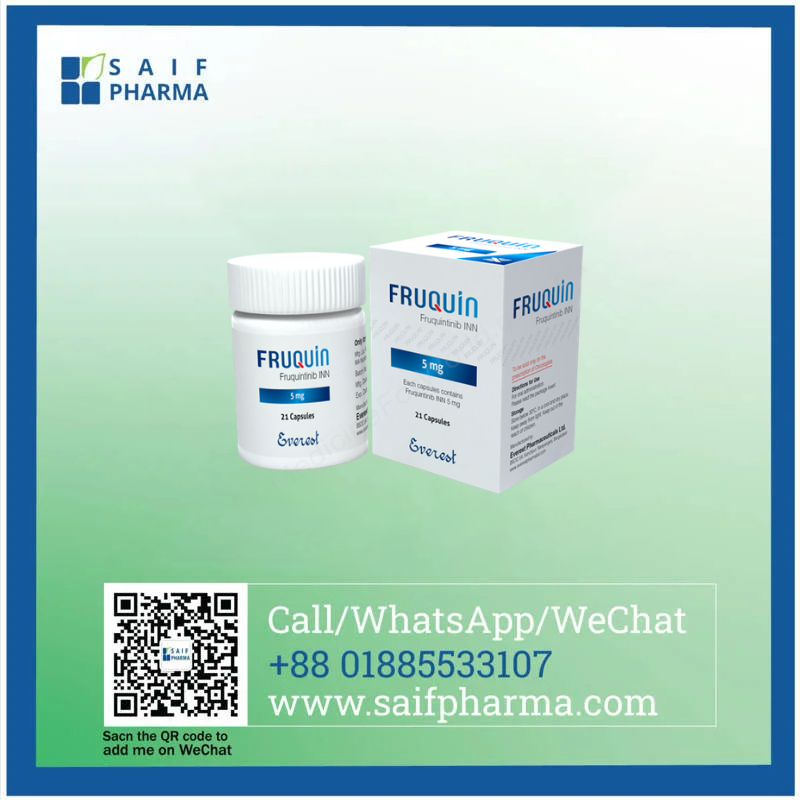
Fruquin 5 mg contains Fruquintinib, a potent, highly selective, oral small-molecule inhibitor of vascular endothelial growth factor receptors (VEGFR-1, VEGFR-2, and VEGFR-3). Manufactured by Everest Pharmaceuticals Ltd. and supplied globally by Saif Pharma, Fruquin represents a major therapeutic advancement in precision oncology. It is specifically designed to treat adult patients with metastatic colorectal cancer (mCRC) who have progressed on or are intolerant to standard therapies, providing a targeted approach to limiting tumor blood supply and halting disease progression.
Therapeutic Applications
Fruquin 5 mg is primarily indicated for:
Metastatic Colorectal Cancer (mCRC): For adult patients with metastatic colorectal cancer who have been previously treated with fluoropyrimidine-, oxaliplatin-, and irinotecan-based chemotherapy, an anti-VEGF therapy, and, if RAS wild-type, an anti-EGFR therapy.
Refractory Gastrointestinal Tumors: Utilized in clinical settings for patients whose advanced gastrointestinal cancers have shown resistance to conventional first- and second-line treatments.
Mechanism of Action
Fruquintinib works by restricting the blood supply that tumors depend on to survive and expand, a process known as anti-angiogenesis:
VEGFR Blockade: It selectively binds to and inhibits VEGFR-1, -2, and -3 tyrosine kinases. These receptors play a crucial role in vascular endothelial cell proliferation, migration, and tube formation.
Starving the Tumor: By blocking these receptors, Fruquin cuts off the signaling pathways that tumors use to build new blood vessels (angiogenesis).
Sparing Healthy Tissues: Its high selectivity minimizes off-target toxicity, allowing for maximum inhibition of the target receptors with a more manageable safety profile compared to non-selective kinase inhibitors.
Pharmacokinetic Profile
Absorption: Readily absorbed after oral administration, reaching peak plasma concentration ($T_{max}$) within approximately 2 to 4 hours.
Distribution: Highly bound to human plasma proteins (~95%), ensuring a steady concentration in systemic circulation.
Metabolism: Primarily metabolized in the liver via the CYP3A4 pathway, with minor contributions from CYP2C9 and CYP2C19.
Elimination: Displays a terminal elimination half-life of approximately 42 hours, making it highly effective for standard once-daily cyclic dosing.
Dosage & Administration
Standard Adult Regimen: The recommended dosage is 5 mg taken orally once daily.
Dosing Cycle: Taken consecutively for 3 weeks on, followed by 1 week off (a complete 28-day cycle).
Instructions: Tablets must be swallowed whole with a glass of water. Do not crush, split, or chew. It can be taken with or without food at the same time each day.
Missed Doses: If a dose is missed by less than 12 hours, the patient should take it immediately. If more than 12 hours have passed, skip the missed dose and resume the regular schedule the next day. Do not double the dose.
Clinical Considerations & Safety
Hypertension: High blood pressure is a common class-effect of VEGF inhibitors. Blood pressure must be well-controlled before starting treatment and monitored weekly during the first cycle.
Palmar-Plantar Erythrodysesthesia (Hand-Foot Syndrome): Can cause redness, swelling, and pain on the palms of the hands and soles of the feet. Topical moisturizers and temporary dose modifications can manage this.
Hemorrhage & Bleeding: Serious and sometimes fatal hemorrhagic events have been reported. Monitor patients closely for signs of unusual bleeding.
Proteinuria: Urine protein should be monitored periodically. Treatment may need to be suspended if significant protein levels are detected in the urine.
Wound Healing Impairment: Because VEGF inhibitors affect blood vessel growth, Fruquin must be discontinued at least 2 weeks prior to elective surgery and delayed for at least 2 weeks following major surgery until adequate wound healing is observed.
Special Populations
Pregnancy & Lactation: Fruquintinib can cause embryo-fetal harm. Women of reproductive potential must use highly effective, non-hormonal contraception during treatment and for at least 2 weeks after the last dose. Breastfeeding is prohibited during treatment.
Hepatic Impairment: Use with caution in patients with mild-to-moderate liver dysfunction; it has not been sufficiently studied in patients with severe hepatic impairment.