






Overview
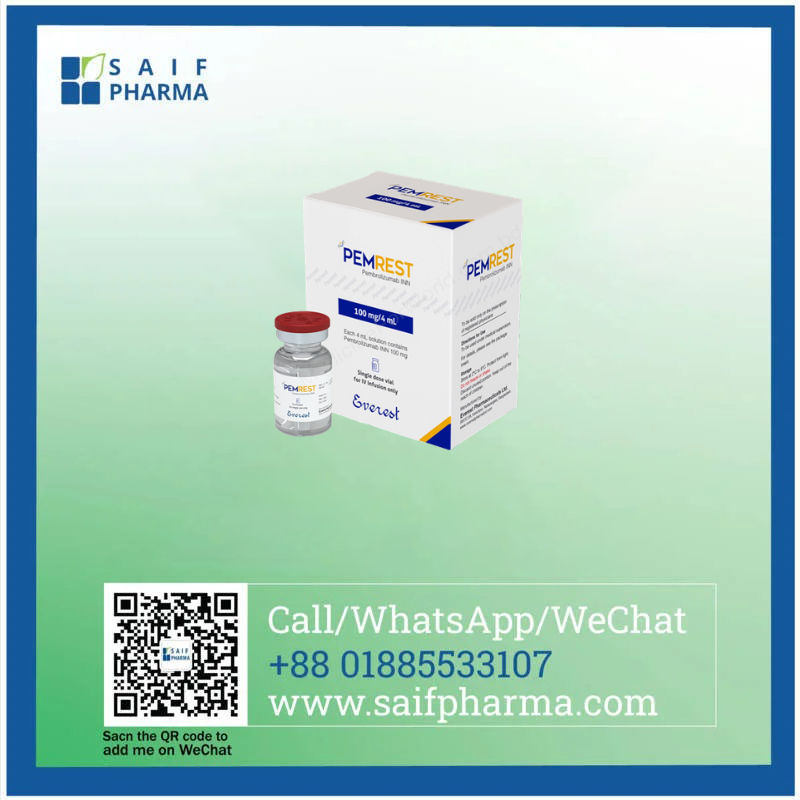
Pemrest 100 mg contains Pembrolizumab, a revolutionary humanized monoclonal IgG4 kappa isotype antibody designed for precision cancer immunotherapy. Manufactured by Everest Pharmaceuticals Ltd. and supplied globally by Saif Pharma, Pemrest functions as an immune checkpoint inhibitor. Rather than targeting cancer cells directly, it empowers the patient’s own immune system to recognize and destroy tumors. It is formulated as a preservative-free, sterile solution for intravenous infusion containing 100 mg of Pembrolizumab per 4 mL vial (25 mg/mL).
Therapeutic Applications
Pembrolizumab is highly versatile and indicated either as monotherapy or in combination with chemotherapy/targeted drugs for an extensive array of advanced malignancies, including:
Advanced Melanoma: For adult and pediatric patients with unresectable or metastatic melanoma, or as an adjuvant treatment following complete surgical resection.
Non-Small Cell Lung Cancer (NSCLC): First-line treatment for metastatic squamous or non-squamous NSCLC (often with platinum-based chemotherapies), or as a standalone agent for tumors highly expressing PD-L1.
Classical Hodgkin Lymphoma (cHL): For adult and pediatric patients with refractory cHL or those who have relapsed after prior systemic lines of therapy.
Urothelial & Colorectal Cancers: For patients with advanced bladder cancers or Microsatellite Instability-High (MSI-H) / Mismatch Repair Deficient (dMMR) solid tumors, including colorectal cancer.
Other Solid Tumors: Broadly utilized in managing advanced Head and Neck Squamous Cell Carcinoma (HNSCC), Cervical Cancer, Triple-Negative Breast Cancer (TNBC), Renal Cell Carcinoma (RCC), and Gastric/Esophageal cancers.
Mechanism of Action
Pembrolizumab blocks the pathways that cancer cells use to hide from immune surveillance:
The Immune Brake: Tumor cells often express PD-L1 and PD-L2 ligands. When these ligands bind to the PD-1 receptor on T cells, they put a “brake” on the immune system, forcing T cells to ignore the tumor.
Checkpoint Blockade: Pemrest selectively binds to the PD-1 receptor on cytotoxic T-lymphocytes, completely blocking its interaction with the tumor’s PD-L1 and PD-L2 ligands.
T-Cell Reactivation: By releasing this molecular brake, Pembrolizumab reactivates tumor-specific T cells, allowing them to rapidly proliferate, secrete inflammatory cytokines, and actively destroy the cancer cells.
Pharmacokinetic Profile
Distribution: Exhibits a limited volume of distribution (~6 L), typical for a large monoclonal antibody, remaining primarily confined to the vascular and interstitial spaces.
Metabolism: Cleared from circulation via non-specific proteolytic catabolism into small peptides and individual amino acids, completely independent of hepatic CYP450 enzyme pathways.
Elimination: Displays a prolonged terminal elimination half-life of approximately 22 days, providing a sustained therapeutic window that supports extended, multi-week dosing schedules.
Dosage & Administration
Route of Administration: Strictly via Intravenous (IV) Infusion over 30 minutes. It must never be administered as an IV push or bolus injection.
Standard Adult Dosing Regimen: Administered as a fixed-dose schedule of either 200 mg every 3 weeks OR 400 mg every 6 weeks until disease progression or unacceptable toxicity.
Preparation Protocol: The solution must be visually inspected for particulate matter or discoloration prior to administration. The calculated dose must be withdrawn from the 100 mg/4 mL vial and diluted into an IV infusion bag containing either 0.9% Sodium Chloride (Normal Saline) or 5% Dextrose to a final concentration between 1 mg/mL and 10 mg/mL.
In-Line Filter Requirement: Must be administered through an intravenous infusion set equipped with a sterile, non-pyrogenic, low protein-binding in-line filter (pore size 0.2 to 5.0 $\mu$m).
Clinical Considerations & Safety
Because Pembrolizumab upregulates the immune system, it can cause immune-mediated adverse reactions where T cells attack healthy organs.
Immune-Mediated Pneumonitis: Lung inflammation can occur and may be life-threatening. Monitor for cough, chest pain, or shortness of breath. Withhold for moderate cases and permanently discontinue for severe pneumonitis.
Immune-Mediated Colitis: Monitor for severe diarrhea, severe abdominal pain, or blood/mucus in the stool.
Immune-Mediated Endocrinopathies: Can trigger severe hypophysitis, thyroid dysfunction (hypothyroidism/hyperthyroidism), and Type 1 Diabetes Mellitus. Patients may require lifelong hormone replacement therapies.
Immune-Mediated Hepatitis & Nephritis: Regular baseline and periodic liver function tests (ALT/AST/Bilirubin) and renal function assays (Serum Creatinine) are mandatory.
Management Protocol: Mild-to-moderate immune reactions are managed by withholding the drug. Severe or life-threatening reactions require permanent discontinuation and immediate initiation of systemic high-dose corticosteroids (1 to 2 mg/kg/day of prednisone or equivalent) followed by a gradual taper.
Pregnancy & Contraception: Based on its mechanism of action, Pembrolizumab can cause severe fetal harm. Females of reproductive potential must utilize highly effective contraception during treatment and for at least 4 months following the final dose.
Lactation: Due to potential risks of serious adverse reactions in a nursing infant, breastfeeding is not recommended during therapy and for 4 months post-dose.
Storage & Handling
Store unopened vials in a refrigerator between 2°C to 8°C. Keep inside the original carton to protect from light. Do not freeze or shake.
Diluted infusion solutions may be stored at room temperature for up to 6 hours (including infusion time) or under refrigeration (2°C to 8°C) for no more than 96 hours.